Updated November 2026.
Your hair routine has to work where you live. For Scottsdale clients, that makes local water and seasonal weather useful starting points alongside the history of your hair color, heat styling and extensions.
This reference brings together 100 cited statistics and research findings. Arizona government data describe the local setting; laboratory studies explain specific fibre measurements. They are clearly labeled so a result from a small overseas experiment is never presented as a finding about Arizona clients.
Key Takeaways
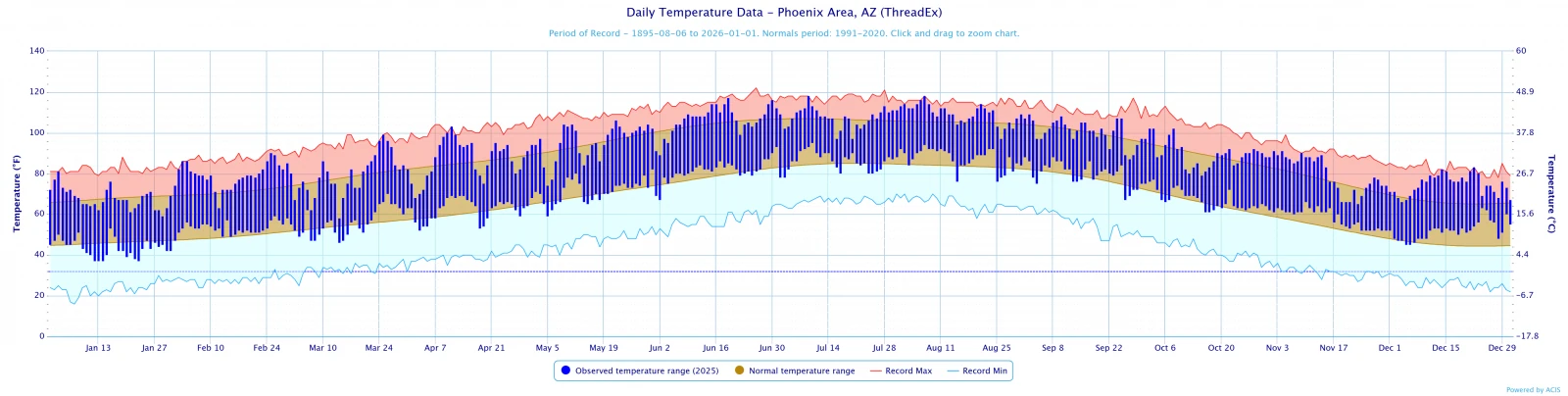
- Days reaching at least 100°F: 122. Phoenix station, calendar 2025. (National Weather Service Phoenix, January 2026).
- Annual average relative humidity: 32%. Phoenix station, calendar 2025. (National Weather Service Phoenix, January 2026).
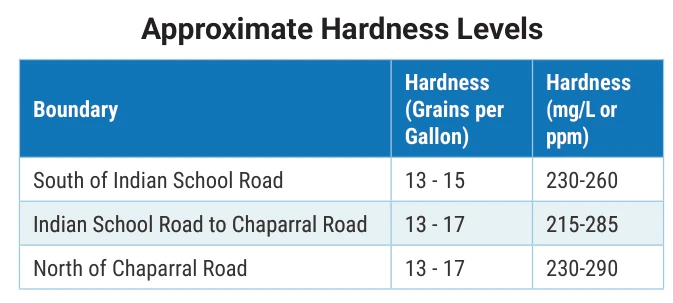
- South of Indian School Road: approximate hardness: 230–260 mg/L. Scottsdale approximate municipal supply zones, 2026 report. (City of Scottsdale Water, April 2026).
- Hard versus soft water: magnesium deposition difference: Higher with hard water, P = 0.001. 20-volunteer paired-sample experiment; Saudi Arabia, three weeks. (Alahmmed and colleagues, November 2017).
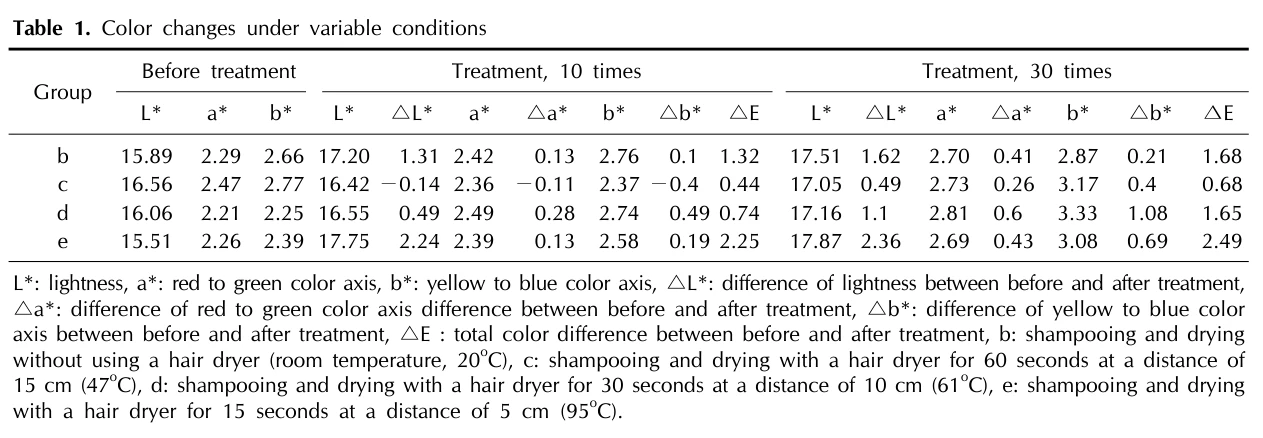
- 95°C group after repeated washing/drying: Most severe surface damage among tested groups. 30-cycle laboratory experiment; temperature, distance and time varied together. (Lee and colleagues, November 2011).
- Repeated dryer group: water content: 10.35% ± 0.17%. Separate 2025 in-vitro study; prolonged oven exposure is a damage model, not a styling recommendation. (Zi and colleagues, July 2025).
- After one oxidative treatment: mean cuticle step height: 343.3 ± 75.9 nm. Single-donor hair under the study’s oxidative lightening procedure; mean ± SEM. (Kwon and colleagues, September 2024).
- Ten treatments: AFM stiffness versus untreated control: 10% higher. Same single-donor experiment; greater stiffness/strength in a test does not mean healthier hair. (Kwon and colleagues, September 2024).
- Control hair at 14 g load: mean cycles to failure: 531. Moving-loop fatigue experiment; processing times describe the experiment and are not instructions. (Taylor and colleagues, June 2024).
- Split-prone hair at 14 g load: mean cycles to failure: 207. Moving-loop fatigue experiment; processing times describe the experiment and are not instructions. (Taylor and colleagues, June 2024).
- Hairstylist category: 1,251 active licenses. Arizona administrative snapshot, June 2025; exam categories also have reciprocity routes. (Arizona Auditor General / Walker & Armstrong, September 2025).
- Licensed establishments: 16,490. Arizona administrative snapshot, June 2025; categories include non-hair specialties. (Arizona Auditor General / Walker & Armstrong, September 2025).
What does the desert climate mean for an Arizona hair routine?
A Scottsdale routine should account for the season. Phoenix station data provide nearby climate context, while individual hair history and styling habits determine what belongs in a consultation.
How long does the regional heat season last?
The annual record shows sustained heat and low average humidity. These are outdoor weather measurements, not temperatures reached by hair fibres or recommended tool settings. Average humidity also hides daily and seasonal variation; it cannot describe the conditions inside a salon, car or home.
| Measurement or finding | Reported result | Primary source |
|---|---|---|
| Annual mean temperature | 78.0°F | (National Weather Service Phoenix, January 2026) |
| Annual average daily maximum | 89.7°F | (National Weather Service Phoenix, January 2026) |
| Days reaching at least 90°F | 181 | (National Weather Service Phoenix, January 2026) |
| Days reaching at least 110°F | 37 | (National Weather Service Phoenix, January 2026) |
How does the first half of the year change?
Monthly average highs show the transition from winter to summer. An average daily high is not the temperature on every day of the month. Use the seasonal pattern to describe your commute, outdoor time and styling schedule to your stylist, rather than treating weather as a diagnosis.
| Measurement or finding | Reported result | Primary source |
|---|---|---|
| January average daily high | 67.8°F | (National Weather Service Phoenix, January 2026) |
| February average daily high | 79.0°F | (National Weather Service Phoenix, January 2026) |
| March average daily high | 79.5°F | (National Weather Service Phoenix, January 2026) |
| April average daily high | 87.1°F | (National Weather Service Phoenix, January 2026) |
| May average daily high | 95.6°F | (National Weather Service Phoenix, January 2026) |
| June average daily high | 106.2°F | (National Weather Service Phoenix, January 2026) |
How warm is the second half of the year?
Summer conditions continue into the early autumn in this regional record. Scottsdale microclimates can differ from the Phoenix station. These figures help frame local conversations about convenience and maintenance; they do not establish a weather threshold at which hair color fades or extensions need replacing.
| Measurement or finding | Reported result | Primary source |
|---|---|---|
| July average daily high | 107.6°F | (National Weather Service Phoenix, January 2026) |
| August average daily high | 109.3°F | (National Weather Service Phoenix, January 2026) |
| September average daily high | 100.5°F | (National Weather Service Phoenix, January 2026) |
| October average daily high | 89.5°F | (National Weather Service Phoenix, January 2026) |
| November average daily high | 79.9°F | (National Weather Service Phoenix, January 2026) |
| December average daily high | 74.5°F | (National Weather Service Phoenix, January 2026) |
What does Scottsdale water data actually say about hair washing?
Start with the local water report before attributing every texture change to hard water. The city’s mineral measurements and small hair-fibre experiments answer different questions.
Does hardness vary across Scottsdale?
Yes. The city reports approximate hardness ranges for municipal supply zones. They describe the supply, not a tested value at PR Hair AZ or your shower. Building plumbing, private wells and treatment equipment can change the water that reaches a tap; no property-specific result is inferred here.
| Measurement or finding | Reported result | Primary source |
|---|---|---|
| Indian School to Chaparral: approximate hardness | 215–285 mg/L | (City of Scottsdale Water, April 2026) |
| North of Chaparral: approximate hardness | 230–290 mg/L | (City of Scottsdale Water, April 2026) |
Which mineral and chemistry measurements are available?
Scottsdale reports several measurements alongside hardness. The ranges below span monitoring results and should not be added together or treated as one water sample. The chlorine item is an operating goal, identified separately from detected values. These figures alone do not prove that a filter or softener will improve hair.
| Measurement or finding | Reported result | Primary source |
|---|---|---|
| Calcium: detected range | 61.9–81.3 ppm | (City of Scottsdale Water, April 2026) |
| Magnesium: detected range | 27–42 ppm | (City of Scottsdale Water, April 2026) |
| Alkalinity: detected range | 113–135 ppm | (City of Scottsdale Water, April 2026) |
| pH: detected range | 6.7–8.2 | (City of Scottsdale Water, April 2026) |
| Total dissolved solids: detected range | 325–710 ppm | (City of Scottsdale Water, April 2026) |
| Chlorine residual: city operating goal | 0.5–1.5 ppm | (City of Scottsdale Water, April 2026) |
Do controlled studies consistently show hard-water damage?
No. The selected studies found different results for mineral deposition, mechanical properties and visible surface damage. A nonsignificant finding does not prove that all water conditions are equivalent. It does mean that these experiments cannot support a blanket claim that Scottsdale water causes breakage or hair loss.
| Measurement or finding | Reported result | Primary source |
|---|---|---|
| Hard versus distilled water: tensile-strength comparison | Not significant, P = 0.858 | (Srinivasan and colleagues, July 2013) |
| Hard versus distilled water: elasticity comparison | Not significant, P = 0.874 | (Srinivasan and colleagues, July 2013) |
| Hard versus soft water: calcium deposition difference | Not significant, P = 0.28 | (Alahmmed and colleagues, November 2017) |
| Hair-surface damage after repeated washing | No significant group difference | (Alahmmed and colleagues, November 2017) |
What do experiments show about heat and drying?
Drying technique involves temperature, distance and exposure time together. Laboratory comparisons help explain why those details belong in a styling conversation, but do not establish one universal safe setting.
What changed after the earlier drying cycles?
The older experiment measured color difference after repeated washing and drying. Its ΔE scale combines color coordinates; it is not a percentage of lost color. The groups also differed in dryer distance and duration. Surface microscopy provides another outcome, so a color reading alone does not describe total fibre condition.
| Measurement or finding | Reported result | Primary source |
|---|---|---|
| Ambient drying: total color difference after 10 cycles | 1.32 ΔE | (Lee and colleagues, November 2011) |
| 47°C dryer group: total color difference after 10 cycles | 0.44 ΔE | (Lee and colleagues, November 2011) |
| 61°C dryer group: total color difference after 10 cycles | 0.74 ΔE | (Lee and colleagues, November 2011) |
| 95°C dryer group: total color difference after 10 cycles | 2.25 ΔE | (Lee and colleagues, November 2011) |
| 47°C group after repeated washing/drying | Longitudinal cuticle cracks observed | (Lee and colleagues, November 2011) |
What happened after additional repeated drying?
The same experiment also reported later color measurements. These results describe its commercial hair tresses under controlled treatment, not the lifespan of a client’s gloss, balayage or extensions. The study did not compare salon services, heat-protection brands or Arizona weather, so those outcomes cannot be inferred from its table.
| Measurement or finding | Reported result | Primary source |
|---|---|---|
| Ambient drying: total color difference after 30 cycles | 1.68 ΔE | (Lee and colleagues, November 2011) |
| 47°C dryer group: total color difference after 30 cycles | 0.68 ΔE | (Lee and colleagues, November 2011) |
| 61°C dryer group: total color difference after 30 cycles | 1.65 ΔE | (Lee and colleagues, November 2011) |
| 95°C dryer group: total color difference after 30 cycles | 2.49 ΔE | (Lee and colleagues, November 2011) |
What does a newer heat-damage model measure?
A separate research team measured moisture, break work and released protein. Its repeated-dryer group differs from its prolonged oven model. The latter deliberately creates damage for testing products. The paper’s reported units are retained below; oven exposure is not a home routine or a recommendation to apply heat for those durations.
| Measurement or finding | Reported result | Primary source |
|---|---|---|
| Virgin hair: water content | 11.23% ± 0.03% | (Zi and colleagues, July 2025) |
| 60°C, 24-hour oven model: water content | 10.20% ± 0.10% | (Zi and colleagues, July 2025) |
| Virgin hair: break work, reported units | 17.15 ± 2.66 J | (Zi and colleagues, July 2025) |
| Repeated dryer group: break work, reported units | 12.42 ± 2.13 J | (Zi and colleagues, July 2025) |
| 60°C, 24-hour oven model: break work | 12.20 ± 2.38 J | (Zi and colleagues, July 2025) |
| 90°C, 24-hour oven exposure: break work | 11.20 ± 2.16 J | (Zi and colleagues, July 2025) |
| 60°C, 24-hour oven model: released protein | 1.68 ± 0.03 mg/g | (Zi and colleagues, July 2025) |
What changes when hair is repeatedly colored or lightened?
Bring a complete processing history to a color consultation. Research shows that visible surface condition, stiffness, moisture and fracture behavior can change in different directions, making a single strength number a poor summary.
What do microscopy measurements reveal?
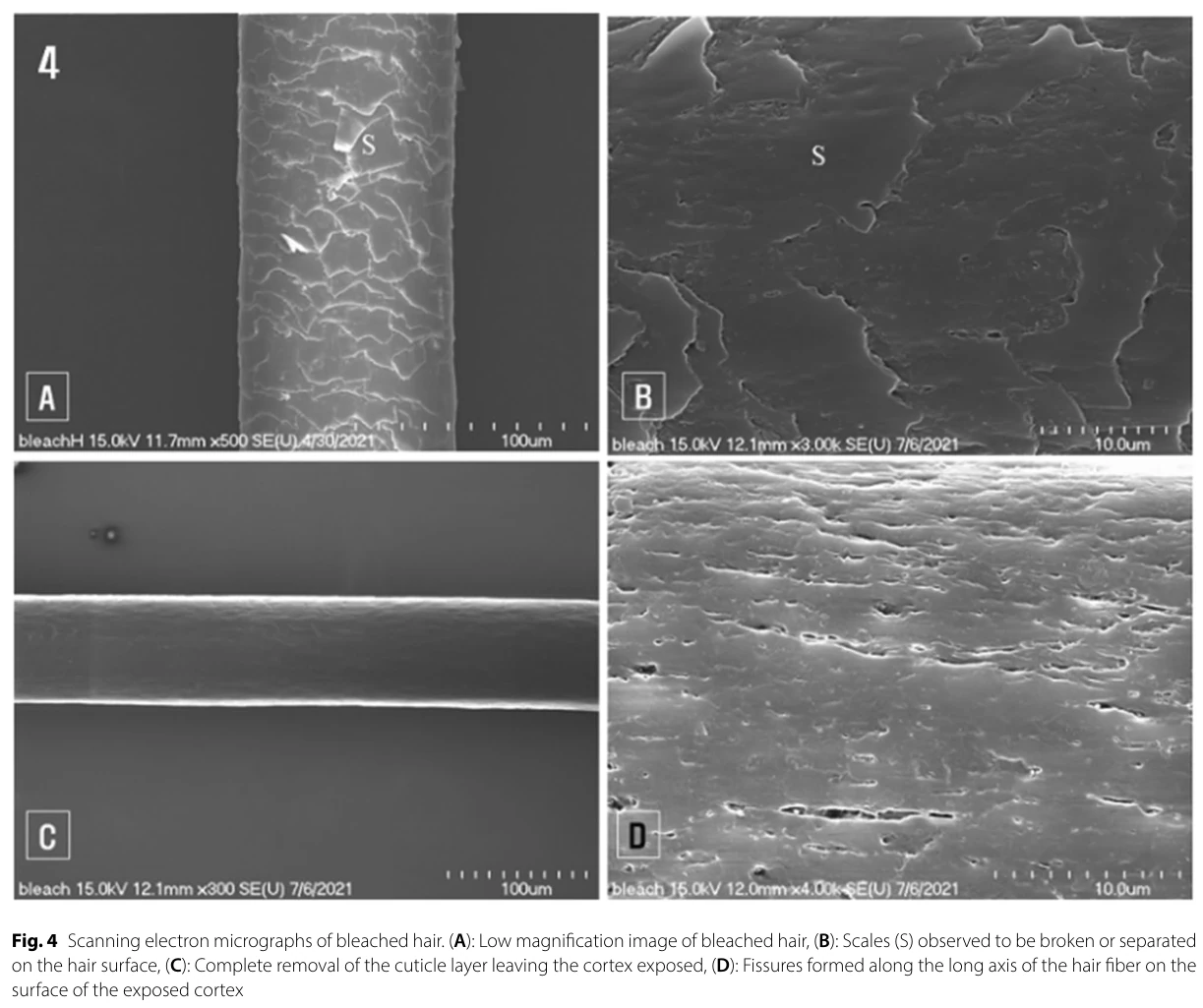
Researchers measured cuticle steps and separately photographed changes after repeated bleaching. These are different experiments using different procedures. Neither establishes a maximum number of color appointments. The practical connection is the importance of discussing previously treated lengths before planning further lightening or choosing a maintenance schedule.
| Measurement or finding | Reported result | Primary source |
|---|---|---|
| Untreated hair: mean cuticle step height | 430.2 ± 52.7 nm | (Kwon and colleagues, September 2024) |
| After the study’s three bleaching treatments: cuticle | Broken and detached scales observed | (Kim, Oh and Chang, December 2024) |
| After the study’s three bleaching treatments: exposed cortex | Longitudinal fissures observed | (Kim, Oh and Chang, December 2024) |
Does a higher laboratory strength value mean healthier hair?
No. A fibre can become stiffer or withstand a higher measured stress while showing surface damage. AFM attraction is an interaction with a probe, not how strongly hairs stick together when brushing. These endpoints do not rank professional color techniques or prove that a product repairs every type of damage.
| Measurement or finding | Reported result | Primary source |
|---|---|---|
| Seven treatments: AFM stiffness versus untreated control | 4% higher | (Kwon and colleagues, September 2024) |
| Untreated hair: AFM attraction force | 0.591 ± 0.140 nN | (Kwon and colleagues, September 2024) |
| One treatment: AFM attraction force | 0.367 ± 0.076 nN | (Kwon and colleagues, September 2024) |
| Ten treatments: tensile elastic modulus versus control | 190% higher | (Kwon and colleagues, September 2024) |
| Treated hair: yield and fracture strength versus control | Approximately 40–70% higher | (Kwon and colleagues, September 2024) |
| Untreated hair: typical fracture strain | Around 47% | (Kwon and colleagues, September 2024) |
| Treated hair: fracture strain | Above 50% | (Kwon and colleagues, September 2024) |
What changed in water and chemical measurements?
The same donor-hair experiment examined water content and spectroscopic signals. Transmittance is an optical measurement, not a percentage of protein removed. Changes in attraction describe a laboratory probe interaction. Taken together, the observations support asking about treatment history rather than translating one number into a promise about a finished hairstyle.
| Measurement or finding | Reported result | Primary source |
|---|---|---|
| Untreated hair: AFM stiffness | 0.163 ± 0.007 nN/nm | (Kwon and colleagues, September 2024) |
| Three to five treatments: AFM attraction reduction | 38–43% | (Kwon and colleagues, September 2024) |
| Seven to ten treatments: AFM attraction reduction | 50–51% | (Kwon and colleagues, September 2024) |
| First treatment: hair water-content reduction | 40% | (Kwon and colleagues, September 2024) |
| One to three treatments: amide-I transmittance increase | 16–20% | (Kwon and colleagues, September 2024) |
| Five to ten treatments: amide-I transmittance increase | 30–38% | (Kwon and colleagues, September 2024) |
Planning a change? Read balayage versus highlights and the first hair-color appointment checklist before discussing your goals with Patty.
What do breakage tests tell us about maintaining length?
Retaining length involves avoiding unnecessary fibre breakage, but laboratory tests are specific to the hair and loading conditions tested. They are not measurements of growth speed or guarantees for an extension method.
Do simple strength tests distinguish split-prone hair?
Not reliably in the small donor comparison selected here. Tensile results varied substantially and the reported group differences were not statistically significant. The study’s split-prone label describes one donor’s history, not a diagnostic category. A straight-pull strength test also imposes different forces from a tangle moving through a brush.
| Measurement or finding | Reported result | Primary source |
|---|---|---|
| Control donor: strand yield strength | 47.1 ± 23.0 MPa | (Taylor and colleagues, June 2024) |
| Split-prone donor: strand yield strength | 57.3 ± 27.3 MPa | (Taylor and colleagues, June 2024) |
| Control donor: strand tensile strength | 153.0 ± 59.4 MPa | (Taylor and colleagues, June 2024) |
| Split-prone donor: strand tensile strength | 144.2 ± 56.7 MPa | (Taylor and colleagues, June 2024) |
| Control donor: loop tensile strength | 95.2 ± 34.5 MPa | (Taylor and colleagues, June 2024) |
| Split-prone donor: loop tensile strength | 65.4 ± 13.5 MPa | (Taylor and colleagues, June 2024) |
How did hair perform when repeatedly looped?
The moving-loop test produced different failure counts by donor, load and bleaching exposure. Each count belongs to its stated test condition. The bleaching times are experimental exposures, not salon processing instructions. The donor sample is too small to turn these values into population breakage rates or a schedule for trimming hair.
| Measurement or finding | Reported result | Primary source |
|---|---|---|
| Control hair at 26 g load: mean cycles to failure | 255 | (Taylor and colleagues, June 2024) |
| Split-prone hair at 26 g load: mean cycles to failure | 85 | (Taylor and colleagues, June 2024) |
| Control hair bleached 20 minutes, 14 g load | 480 mean cycles to failure | (Taylor and colleagues, June 2024) |
| Control hair bleached 45 minutes, 14 g load | 421 mean cycles to failure | (Taylor and colleagues, June 2024) |
| Control hair bleached 80 minutes, 14 g load | 386 mean cycles to failure | (Taylor and colleagues, June 2024) |
What do conditioning and fatigue models add?
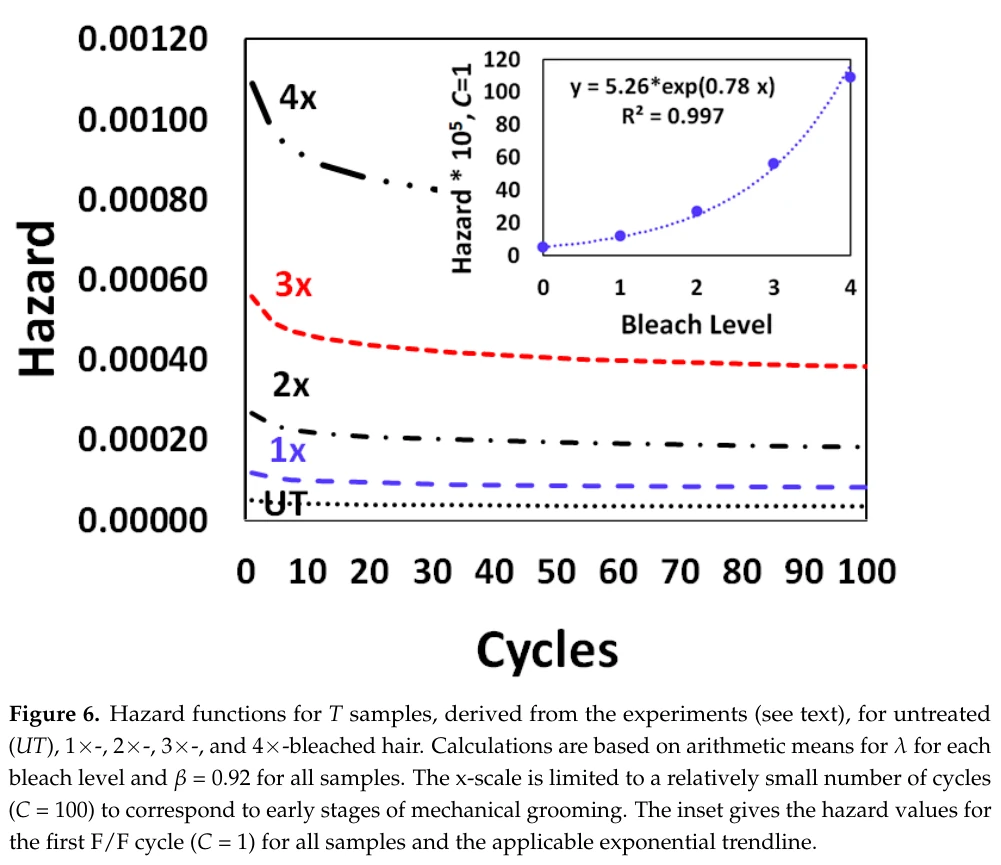
A separate combing study modeled eventual fragment counts, while a newer fatigue study modeled first-cycle failure hazard under cyclic strain. Their units and tests differ. The confidence intervals below are model estimates, not daily shed-hair counts. These studies do not establish how a particular extension installation will perform.
| Measurement or finding | Reported result | Primary source |
|---|---|---|
| Bleached tresses, basic wash: eventual fragments, model interval | 441–889 | (Davies and colleagues, September 2025) |
| Bleached tresses, restoring shampoo: model interval | 87–194 | (Davies and colleagues, September 2025) |
| Bleached tresses, shampoo plus conditioner: model interval | 23–33 | (Davies and colleagues, September 2025) |
| Untreated tress hair: modeled first-cycle failure hazard | 4.9 × 10⁻⁵ | (Wortmann, Welzel and colleagues, September 2026) |
| Four-times-bleached tress hair: modeled first-cycle failure hazard | 109 × 10⁻⁵ | (Wortmann, Welzel and colleagues, September 2026) |
For a service-specific routine, see PR Hair AZ’s hair-extension care guide. Bring product and tool questions to your consultation.
What does Arizona’s professional data tell a salon client?
Arizona’s official categories make useful local context. Keep a historical administrative snapshot separate from current workforce estimates and from verification of an individual professional.
How are individual professionals categorized?
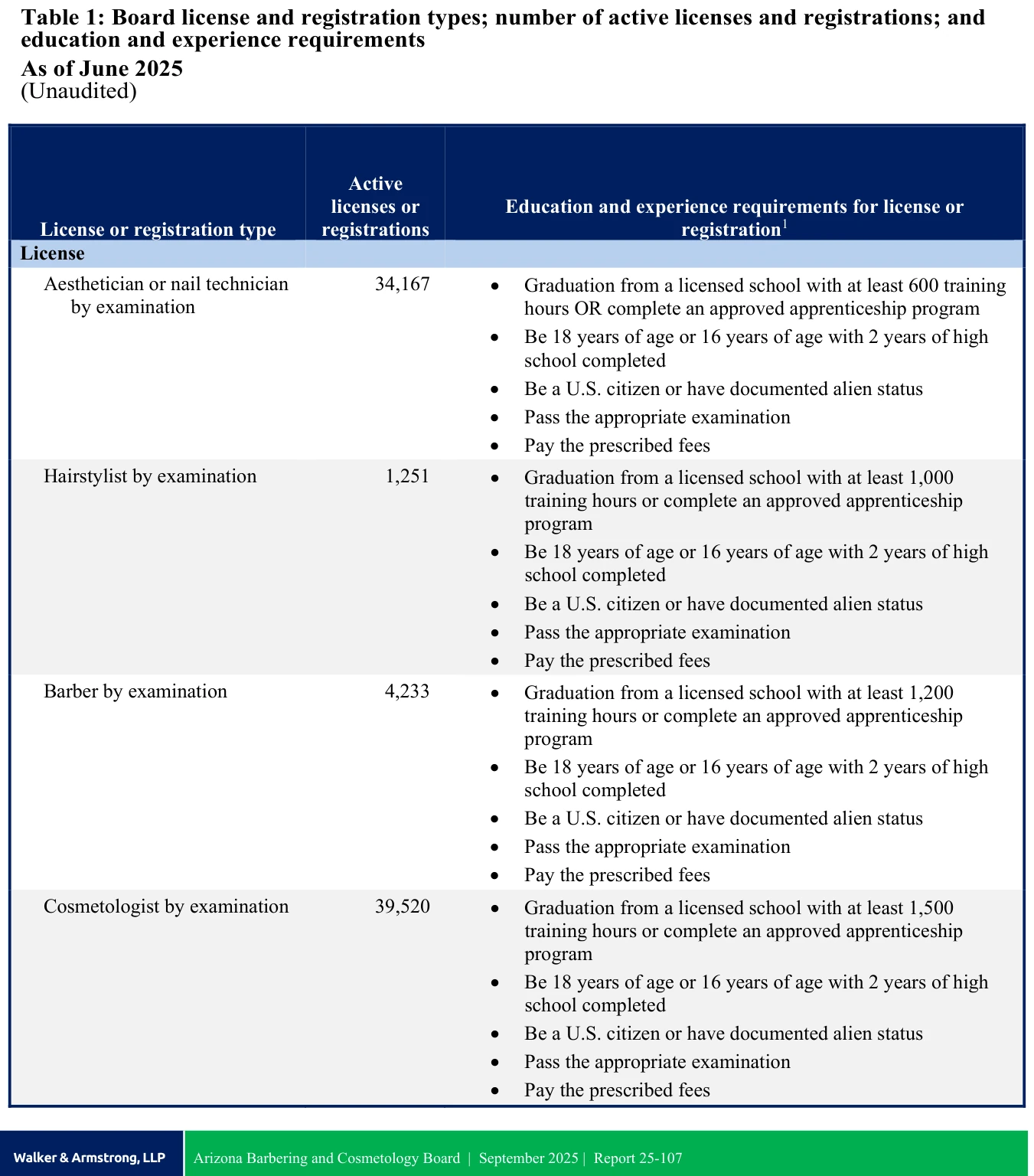
The audit distinguishes several professional categories, including occupations beyond hair services. Its administrative counts are not the number of full-time working hairstylists. A person’s license category and employment status are different facts, and the broad individual total should not be described as the size of Arizona’s salon workforce today.
| Measurement or finding | Reported result | Primary source |
|---|---|---|
| Individual licensees and registrants overseen | 81,214 | (Arizona Auditor General / Walker & Armstrong, September 2025) |
| Barber category | 4,233 active licenses | (Arizona Auditor General / Walker & Armstrong, September 2025) |
| Cosmetologist category | 39,520 active licenses | (Arizona Auditor General / Walker & Armstrong, September 2025) |
| Combined aesthetician / nail-technician category | 34,167 active licenses | (Arizona Auditor General / Walker & Armstrong, September 2025) |
What else falls under board oversight?
The same snapshot includes establishments, instructors, schools and registrations. Those categories explain why the overall total is larger than the number of individual professionals. They should not be summed into an estimate of hair salons, and a registration for another specialty does not itself establish authority to perform hair services.
| Measurement or finding | Reported result | Primary source |
|---|---|---|
| Licensed instructors, all covered specialties | 1,654 | (Arizona Auditor General / Walker & Armstrong, September 2025) |
| Licensed schools, all covered specialties | 176 | (Arizona Auditor General / Walker & Armstrong, September 2025) |
| Eyelash-technician registrations | 2,043 | (Arizona Auditor General / Walker & Armstrong, September 2025) |
| Total active licenses and registrations, all listed types | 99,534 | (Arizona Auditor General / Walker & Armstrong, September 2025) |
What historical training and inspection figures were reported?
The report documents school pathways alongside alternative routes. The numbers below describe that historical report and are not a statement of current licensing law. For current requirements and a professional’s record, use the Arizona board’s public information. Statewide inspection totals do not establish anything about a particular salon’s inspection history.
| Measurement or finding | Reported result | Primary source |
|---|---|---|
| Hairstylist school route in the historical report | At least 1,000 training hours | (Arizona Auditor General / Walker & Armstrong, September 2025) |
| Barber school route in the historical report | At least 1,200 training hours | (Arizona Auditor General / Walker & Armstrong, September 2025) |
| Cosmetologist school route in the historical report | At least 1,500 training hours | (Arizona Auditor General / Walker & Armstrong, September 2025) |
| Inspections reported by the board in calendar 2024 | 3,087 | (Arizona Auditor General / Walker & Armstrong, September 2025) |
Methodology and Sources
The count includes individually cited numerical observations and descriptive experimental findings, not 100 independent studies. Each appears once in the text, either as a takeaway or a table row. Source figures retain their original evidence and can display values also discussed in the article. Primary research, municipal reporting, federal weather observations and a state audit were checked on November 4, 2026. Study dates and historical reporting periods remain visible; the page date does not make older experiments new. Results from different donors, protocols and measurement scales are not pooled. No data establish PR Hair AZ client outcomes, hair-loss treatment effects, extension-method superiority or a property-specific water reading. The editorial refresh plan is monthly; no automatic refresh has been scheduled.
Glossary
- AFM: Atomic force microscopy, used to measure surface features and interactions with a probe.
- ΔE: A unitless total color-difference measurement; it is not percent color loss.
- SEM / SD: Standard error of the mean / standard deviation. In microscopy contexts, SEM also means scanning electron microscopy; the context identifies the meaning.
- MPa: Megapascals, a measure of stress. nm / nN: Nanometers / nanonewtons.
- ppm / mg/L: Parts per million / milligrams per liter. For these water measurements the city reports them as equivalent.
- Hazard: In this article, a model-derived rate of fibre failure under a particular laboratory test.
- Confidence interval: A range expressing uncertainty in an estimate, not the range of individual client outcomes.
Sources
- National Weather Service Phoenix: 2025 Year in Review. January 2026. Calendar 2025; climate summary issued January 2, 2026.
- City of Scottsdale Water: 2026 Water Quality Report. April 2026. 2026 report; monitoring conducted in 2025 unless otherwise noted.
- Alahmmed and colleagues: Scanning electron microscopy study of hair shaft changes related to hardness of water. November 2017. November–December 2017 issue; three-week experiment.
- Srinivasan and colleagues: Effects of hard water on hair. July 2013. July 2013 issue; 30-day laboratory experiment.
- Lee and colleagues: Hair Shaft Damage from Heat and Drying Time of Hair Dryer. November 2011. Published November 3, 2011; repeated washing/drying experiment.
- Zi and colleagues: Establishment of Heat-Damaged Model for Hair. July 2025. Published July 30, 2025; August issue.
- Kwon and colleagues: Quantifying the effects of repeated dyeing: Morphological, mechanical, and chemical changes in human hair fibers. September 2024. Published September 12, 2024.
- Kim, Oh and Chang: Effects of excessive bleaching on hair: comparative analysis of external morphology and internal microstructure. December 2024. Published December 17, 2024.
- Taylor and colleagues: The biomechanics of splitting hairs. June 2024. June 7, 2024 issue date.
- Davies and colleagues: Cyclic combing of untreated and bleached human hair: Analysis of the time-dependent breakage of hair through recording the formation of fibre fragments. September 2025. First published September 10, 2025; April 2026 issue.
- Wortmann, Welzel and colleagues: Multiple Bleaching of Hair: Fatigue Failure Investigations and Weibull Analyses. September 2026. Published September 8, 2026.
- Arizona Auditor General / Walker & Armstrong: Arizona Barbering and Cosmetology Board Sunset Review, Report 25-107. September 2025. Report September 19, 2025; license table as of June 2025; inspection count calendar 2024.
Current local resources: Arizona Barbering & Cosmetology Board and PR Hair AZ’s Scottsdale hair guides.
Explore hair color, balayage, and luxury hair extensions with Patty Roberts in Scottsdale.